Once again, I seem to have chosen the one of the least typical examples of the genre for a genre-based blogathon. “L’armée des ombres” (“Army of Shadows”), Jean-Pierre Melville’s 1969 film about a small group of French Resistance fighters during World War II, is undeniably a spy film. And yet it is strikingly unlike other examples of the genre.
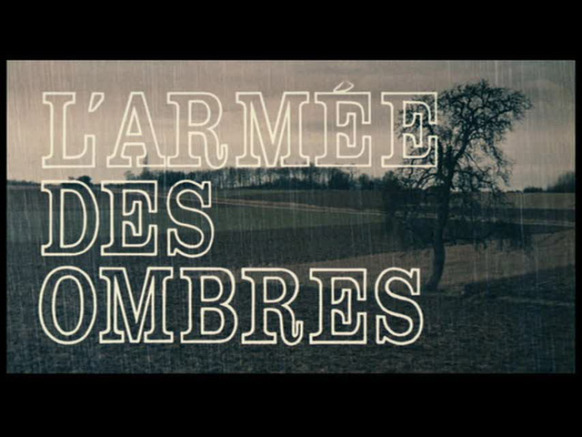
Jean-Pierre Melville’s “Army of Shadows”
Bursts of action happen only between long stretches of mostly silent waiting. The heroes make no perceptible progress against the enemy, managing little more than survival before the betrayal and death they each know is inevitable. As Roger Ebert said in his “Great Movies” review of the film, “This is not a war film. It is about a state of mind.”
As others have remarked, Melville’s film is both obviously artificial (particularly in its sets) and deeply intimate. The coexistence of what ought to be mutually exclusive characteristics is a consistent feature of Melville’s style, a feat critics have described as “difficult to explain” and “miraculous.” It gives his gangster films a kind of lived-in mythic quality, and it is an uncannily appropriate tone for a film about underground spies during an occupation. The résistants are estranged from their surroundings, and to a great extent from each other, though what they do couldn’t be more personal.
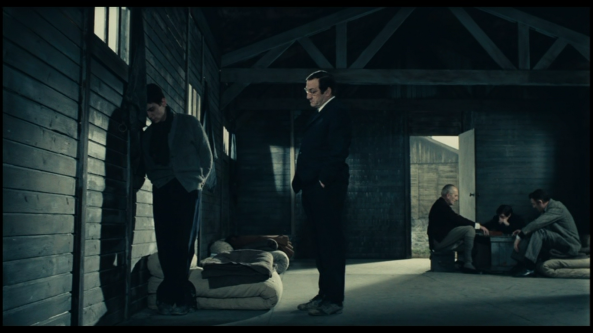
Philippe Gerbier (Lino Ventura), center, at the internment camp.
“Army of Shadows” is unmistakably Melville, but it is just as much Lino Ventura’s film (which is particularly interesting given that Melville and Ventura were not on speaking terms during filming). Ventura plays Philippe Gerbier, an electrical engineer operating as a chief of sorts in the Resistance. The film opens as Gerbier is being transported to the most painfully ironic internment camp in France, having been designed by the French for the Germans. The gendarme assures Gerbier he will be “all right” there, as it is “the best in France.” Gerbier gets the most screen time, and he is also the most solid, both physically and mentally, the most reliable spy.
When Gerbier arrives at the internment camp, it seems deserted. The camp director places him in an area originally reserved for German officials—a privilege not lost on Gerbier, who tells the director he is honored. But the following morning, the camp that appeared desolate the night before is teeming with many of the groups the Nazis rounded up—Jews of all nationalities, of course, but also anti-Fascists, Communists, gypsies, and black marketers, among others. (Unsurprisingly there is no mention of, say, gay or disabled prisoners.) When someone in Gerbier’s barracks dies, Kabyle prisoners, members of a Berber ethnic group in Algeria, come to take the corpse.
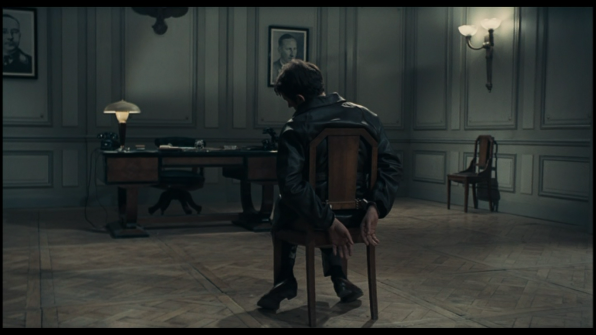
Jean-Francois Jardie (Jean-Pierre Cassel) at the Kommandantur.
Taken to the Kommandantur, Gerbier manages an unlikely escape. From then on, the spies work mostly in the dark, literally as well as figuratively. And though the title refers to the spies themselves, it might as well refer to their environment. The rooms they voluntarily inhabit are shadowy, classic Melvillian palettes of blues and greys. The sound in the film is equally narrowed and heightened. As Gerbier waits for the right moment to distract a guard at the Kommandantur, for example, we suddenly hear the relentless ticking of a clock (and little else).
A common Melvillian motif is his male characters’ chapeaux. In “Army of Shadows,” these become subtle signs that the audience learns to read with the paranoid attention of a spy. Félix (Paul Crauchet), one of Gerbier’s soldiers, wears a bowler at important moments, first when he picks up Dounat (Alain Libolt), a member of the Resistance who betrayed Gerbier to the Germans. In order to avoid further betrayals, they of course will have to murder him. Félix hustles the doomed young man into the car and says to Gerbier, “Dirty job.” Gerbier replies, “You may dislike the hat, but you still have to wear it.” When Félix is later nabbed by the police, his bowler is knocked to the ground and left there. Gerbier, in London for a meeting with de Gaulle, hears of Félix’s arrest. He immediately leaves for France, abandoning his own hat in the London hotel room. Wearing the hat may be the right thing to do, but it is a dirty job, and, furthermore, one that will almost certainly kill you.
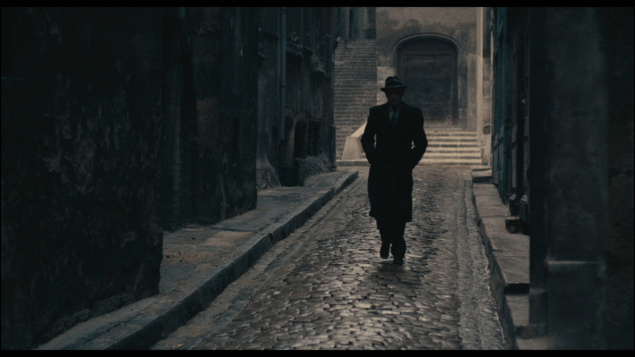 Everything ordinary about these previously ordinary people has been circumscribed, calling to mind Yeats’s “Easter 1916.”
All changed, changed utterly:A terrible beauty is born.
Smiles have been reduced to nearly imperceptible facial tics. There are few safe places; their circle of friends has dwindled to a few fellow resistance fighters, who they know may betray them under Nazi torture. (This is a film that rewards multiple viewings, especially so that you can focus on the actors rather than the subtitles.) Indeed, sometimes even action is built around what the spies don’t know. A pair of brothers, one of whom is a Resistance leader (Paul Meurisse, astonishingly sly and completely open at the same time), never know they are working together. The younger brother, Jean-Francois (Jean-Pierre Cassel, Vincent Cassel’s father), ultimately sacrifices himself—futilely and anonymously—for a comrade, having deceived his fellow fighters in order to help them. This combination of loyalty and fatalism will be familiar to anyone who’s watched “Bob le flambeur” (1956), “Le deuxième souffle” (1966), or “Le cercle rouge” (1970). Perhaps Melville’s own Resistance work is where some of this code comes from.
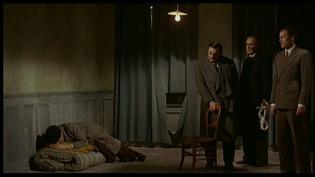
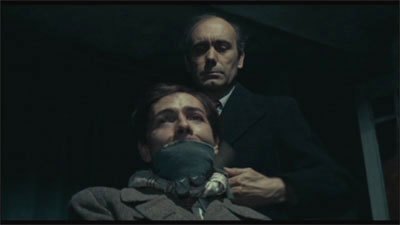
The most telling moment, in a film that seems full of them, might be the scene of the informant’s murder. Like many uncomfortable scenes, this one is drawn out, as the men must decide how to kill the terrified Dounat. Neighbors have moved in next door, so they can’t use their guns. (“The British should have sent the silencers,” one complains.) Dounat, barely more than a boy, must then listen as the men discuss possible methods. When a knife is suggested, a new member of the group, “Le masque,” protests, “Not like that!” confessing, “It’s my first time.” Gerbier wheels on him, horrified. “It’s our first time, too; isn’t that obvious?” One of the tragedies is that it isn’t at all obvious.
Too long a sacrificeCan make a stone of the heart.O when may it suffice?
The Resistance fighters have become so used to confronting such situations that, even though no one wants Dounat to die, discussing his death appears rote, emotionless. The Mask (Claude Mann) is our stand-in at this moment, our way in to understanding, as far as we can, an impossible context.
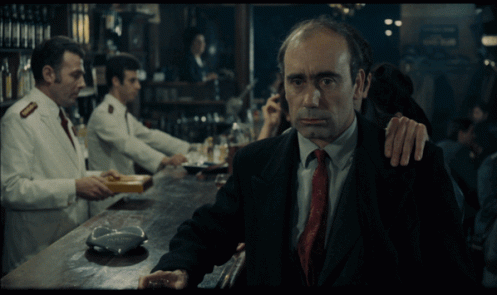
Coming up: Part 2, in which I explain why Simone Signoret is amazing in “Army in Shadows,” and some other stuff, like this:

Thanks so much for choosing this film. It’s astonishing in its power, brutality and intensity. I enjoyed your analysis very much and am looking forward to part 2.
I’m looking forward to part 2. I like the way you invoke Yeats. Thank you for sharing.
C’est une très bon film, surtout en français! Un classique intense…merci pour le partage!
Merci beaucoup! J’apprécie votre site, aussi.
Melville is one of my faves, and despite the fact this steps outside his usual gangster milieu (part of the reason why, I suspect, the critics in France, who usually loved his work, weren’t fans of this film), it’s a perfect demonstration of his style, particularly his use of silence and color. For the former, my favorite scene in the film is the barber scene early on, when Gerbier, on the run, ducks into the barber’s, and with no music and almost no dialogue, Melville has us hanging on the edge of our seats. For the latter, I’ve read interviews with Melville where he talks about wanting to make a color film in black-and-white, and along with LE CERCLE ROUGE (my favorite film of his), this is the closest Melville ever came to it.
Great write-up, and I also am looking forward to part 2.
Thanks so much-and thanks for mentioning about Melville wanting to make a color film in black and white. I didn’t know that, but it is (obviously) such an apt description for the look of this film.
[…] Dounat (Alain Libolt) and of Mathilde are not. I wrote a bit about about Dounat’s murder in Part 1. Mathilde’s murder is its mirror image. Both victims have become dangerous to the Resistance—an […]