Snoopathon: L’armée des ombres (1969) Part 1

Once again, I seem to have chosen the one of the least typical examples of the genre for a genre-based blogathon. “L’armée des ombres” (“Army of Shadows”), Jean-Pierre Melville’s 1969 film about a small group of French Resistance fighters during World War II, is undeniably a spy film. And yet it is strikingly unlike other examples of the genre.
armee-des-ombres-title

Jean-Pierre Melville’s “Army of Shadows”

Bursts of action happen only between long stretches of mostly silent waiting. The heroes make no perceptible progress against the enemy, managing little more than survival before the betrayal and death they each know is inevitable. As Roger Ebert said in his “Great Movies” review of the film, “This is not a war film. It is about a state of mind.”

As others have remarked, Melville’s film is both obviously artificial (particularly in its sets) and deeply intimate. The coexistence of what ought to be mutually exclusive characteristics is a consistent feature of Melville’s style, a feat critics have described as “difficult to explain” and “miraculous.” It gives his gangster films a kind of lived-in mythic quality, and it is an uncannily appropriate tone for a film about underground spies during an occupation. The résistants are estranged from their surroundings, and to a great extent from each other, though what they do couldn’t be more personal.
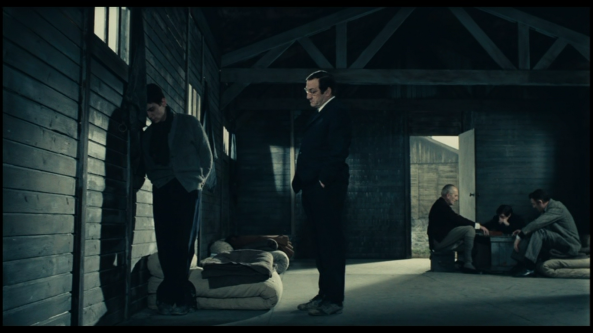
Philippe Gerbier (Lino Ventura), center

Philippe Gerbier (Lino Ventura), center, at the internment camp.

“Army of Shadows” is unmistakably Melville, but it is just as much Lino Ventura’s film (which is particularly interesting given that Melville and Ventura were not on speaking terms during filming). Ventura plays Philippe Gerbier, an electrical engineer operating as a chief of sorts in the Resistance. The film opens as Gerbier is being transported to the most painfully ironic internment camp in France, having been designed by the French for the Germans. The gendarme assures Gerbier he will be “all right” there, as it is “the best in France.” Gerbier gets the most screen time, and he is also the most solid, both physically and mentally, the most reliable spy.

When Gerbier arrives at the internment camp, it seems deserted. The camp director places him in an area originally reserved for German officials—a privilege not lost on Gerbier, who tells the director he is honored. But the following morning, the camp that appeared desolate the night before is teeming with many of the groups the Nazis rounded up—Jews of all nationalities, of course, but also anti-Fascists, Communists, gypsies, and black marketers, among others. (Unsurprisingly there is no mention of, say, gay or disabled prisoners.) When someone in Gerbier’s barracks dies, Kabyle prisoners, members of a Berber ethnic group in Algeria, come to take the corpse.
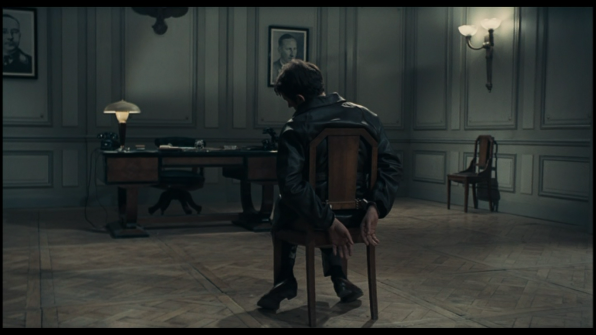
Jean-Francois Jardie (Jean-Pierre Cassel) at the Kommandantur.

Jean-Francois Jardie (Jean-Pierre Cassel) at the Kommandantur.

Taken to the Kommandantur, Gerbier manages an unlikely escape. From then on, the spies work mostly in the dark, literally as well as figuratively. And though the title refers to the spies themselves, it might as well refer to their environment. The rooms they voluntarily inhabit are shadowy, classic Melvillian palettes of blues and greys. The sound in the film is equally narrowed and heightened. As Gerbier waits for the right moment to distract a guard at the Kommandantur, for example, we suddenly hear the relentless ticking of a clock (and little else).

A common Melvillian motif is his male characters’ chapeaux. In “Army of Shadows,” these become subtle signs that the audience learns to read with the paranoid attention of a spy. Félix (Paul Crauchet), one of Gerbier’s soldiers, wears a bowler at important moments, first when he picks up Dounat (Alain Libolt), a member of the Resistance who betrayed Gerbier to the Germans. In order to avoid further betrayals, they of course will have to murder him. Félix hustles the doomed young man into the car and says to Gerbier, “Dirty job.” Gerbier replies, “You may dislike the hat, but you still have to wear it.” When Félix is later nabbed by the police, his bowler is knocked to the ground and left there. Gerbier, in London for a meeting with de Gaulle, hears of Félix’s arrest. He immediately leaves for France, abandoning his own hat in the London hotel room. Wearing the hat may be the right thing to do, but it is a dirty job, and, furthermore, one that will almost certainly kill you.
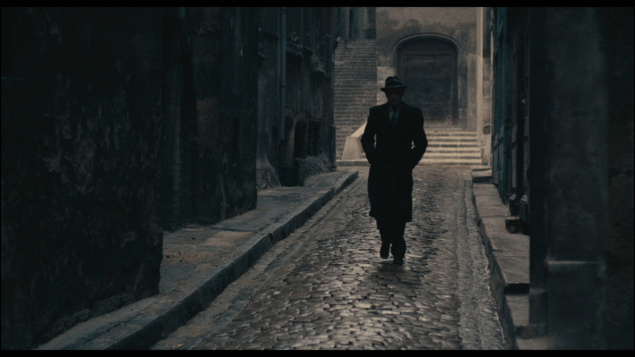
FélixEverything ordinary about these previously ordinary people has been circumscribed, calling to mind Yeats’s “Easter 1916.”

All changed, changed utterly:
A terrible beauty is born.

Smiles have been reduced to nearly imperceptible facial tics. There are few safe places; their circle of friends has dwindled to a few fellow resistance fighters, who they know may betray them under Nazi torture. (This is a film that rewards multiple viewings, especially so that you can focus on the actors rather than the subtitles.) Indeed, sometimes even action is built around what the spies don’t know. A pair of brothers, one of whom is a Resistance leader (Paul Meurisse, astonishingly sly and completely open at the same time), never know they are working together. The younger brother, Jean-Francois (Jean-Pierre Cassel, Vincent Cassel’s father), ultimately sacrifices himself—futilely and anonymously—for a comrade, having deceived his fellow fighters in order to help them. This combination of loyalty and fatalism will be familiar to anyone who’s watched “Bob le flambeur” (1956), “Le deuxième souffle” (1966), or “Le cercle rouge” (1970). Perhaps Melville’s own Resistance work is where some of this code comes from.

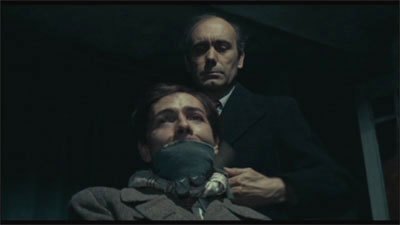
The most telling moment, in a film that seems full of them, might be the scene of the informant’s murder. Like many uncomfortable scenes, this one is drawn out, as the men must decide how to kill the terrified Dounat. Neighbors have moved in next door, so they can’t use their guns. (“The British should have sent the silencers,” one complains.) Dounat, barely more than a boy, must then listen as the men discuss possible methods. When a knife is suggested, a new member of the group, “Le masque,” protests, “Not like that!” confessing, “It’s my first time.” Gerbier wheels on him, horrified. “It’s our first time, too; isn’t that obvious?” One of the tragedies is that it isn’t at all obvious.

Too long a sacrifice
Can make a stone of the heart.
O when may it suffice?

The Resistance fighters have become so used to confronting such situations that, even though no one wants Dounat to die, discussing his death appears rote, emotionless. The Mask (Claude Mann) is our stand-in at this moment, our way in to understanding, as far as we can, an impossible context.
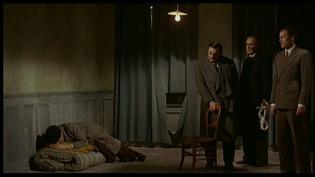
what to do with dounat


murderofdounat


Coming up: Part 2, in which I explain why Simone Signoret is amazing in “Army in Shadows,” and some other stuff, like this:
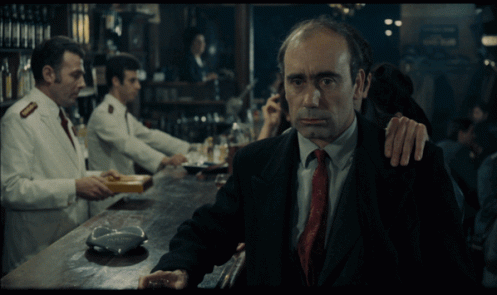
armée_des_ombres_Félix.shoulder

The Merry Widow Waltz: Lubitsch’s “Heaven Can Wait”

This post is part of the Romantic Comedy Blogathon, hosted by Backlots and Carole & Co.!

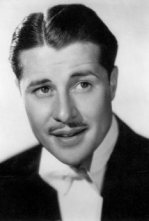
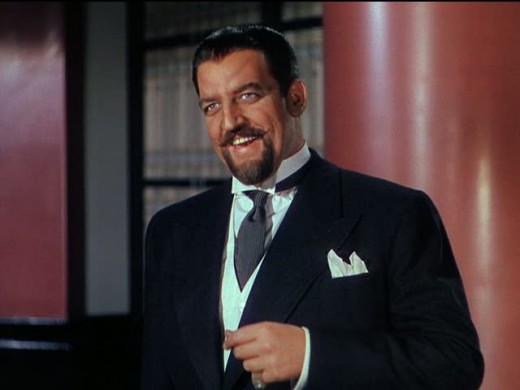
It’s hard to imagine Ernst Lubitsch, director of The Love Parade (1929), Design for Living (1933), and Ninotchka (1939), making something that isn’t a classy, urbane romantic comedy. Heaven Can Wait (1943) is an odd duck, though. For example, not many romantic comedies begin in Hell. Yet, it is here that we, and His Excellency, played by the devilish Laird Cregar, meet Henry Van Cleve (smoothie Don Ameche). Nor is the plot of most romantic comedies structured around its hero’s petition to get in to Hell. His Excellency isn’t sure Henry’s in the right place, but he’s an accommodating fellow and willing to listen.

Why is Hell so...pink?

Why is Hell so…pink? Laird Cregar as His Excellency.

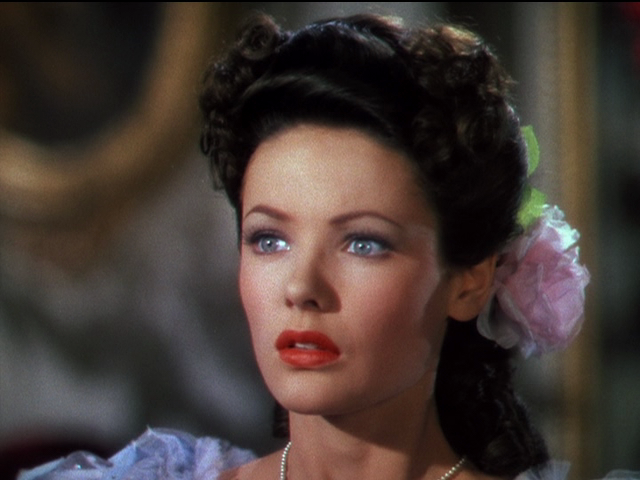
So, Henry tells the story, through flashbacks, of his would-be Casanova history with women, which, it turns out, is mostly his mostly-happy marriage to Martha Strable, played by the luminous Gene Tierney. Despite not being able to point to any outstanding crimes, Henry assures His Excellency, “I have no illusions. I know where I belong.” He adds, “I can safely say my whole life has been one continuous misdemeanor.”

Hell is not impressed with misdemeanors. “My dear Mr. Cleve,” His Excellency retorts, “a passport to Hell is not issued on generalities.”

Given this introduction, it shouldn’t come as a surprise that Henry is an odd duck of a romantic hero, as well. He’s a playboy and a loafer who loves women and

"Just give me five minutes to pull myself together." Don Ameche as Henry Van Cleve.

“Just give me five minutes to pull myself together.” Don Ameche as Henry Van Cleve.

accomplishes nothing over the course of his life, other than loving Martha. When we put Lubitsch’s world in the context of the other, not-so classy world, Henry looks even less heroic. He is a slight and mostly unredeemed character in a world beset by the tragedies of World War I, the Great Depression, and World War II. None of these so much as knocks on the door of Lubitsch’s world of grace, charm, and apparent lightness.

Or do they?

Henry believes he belongs in Hell because he ran around on Martha. It’s not totally clear what this is supposed to mean in the film—but since we’re talking about Lubitsch, and his “continental mind,” it’s probably adultery rather than shameless flirting. What we do know is that, on their tenth wedding anniversary, Martha has had enough and goes home to Kansas. When Henry tries to win her back, he employs what we learn are his usual play-acting and excuses. He starts with the classic How-could-you-do-this-to-me?. It is Henry’s description of their son Jackie’s beginner flirtations with girls, so much like his own, that eventually wins Martha over again, despite her better judgment. And they elope, for the second time.

1181684_original heaven-can-wait-1943-don-ameche-gene-tierney-784065

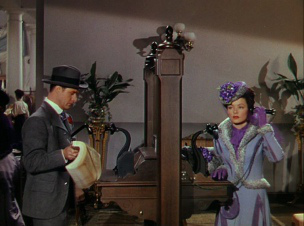
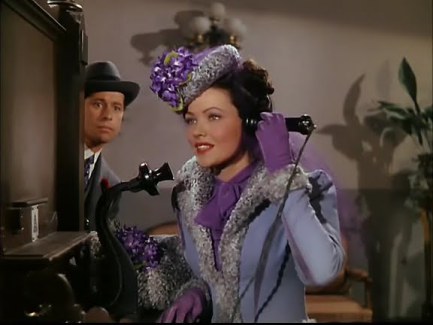
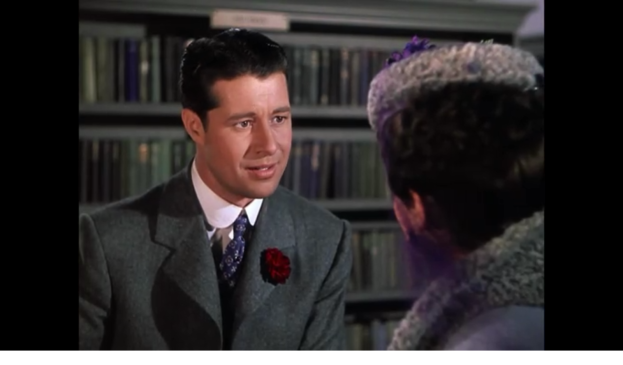
The story of their accidental meeting and first elopement is pure romantic comedy. Henry overhears Martha lying to her mother (!) and, already smitten, follows her to a bookshop. Henry pretends to be a clerk, and when he discovers that Martha wants to buy How to Make Your Husband Happy, he gives one of his first great speeches.

Confessing his deception, he tells Martha:

I took one look at you and followed you into the store. If you’d gone into a restaurant, I would have become a waiter. If you’d walked into a burning building, I’d have become a fireman. If you’d walked into an elevator, I would have stopped between two floors, and we’d have spent the rest of our lives there.

I took one look at you and followed you into the store. If you’d gone into a restaurant, I would have become a waiter. If you’d walked into a burning building, I’d have become a fireman. If you had walked into an elevator, I would have stopped between two floors, and we’d have spent the rest of our lives there.


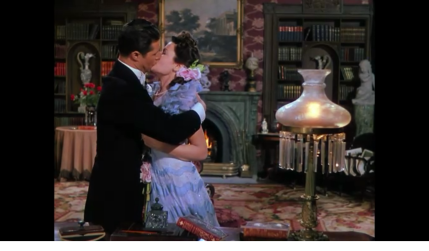
Later that evening, they discover, to their mutual discomfort, that Martha is engaged to Henry’s goody-two-shoes cousin, Albert. The scene in which Henry literally sweeps Martha off her feet is both classic screwball comedy and classic Lubitsch. At the Van Cleves’ to celebrate Henry’s birthday and Albert’s engagement, Martha has the temerity to sneeze during Mrs. Cooper-Cooper’s aria. Albert hustles her into the study in order to avoid any further social disasters. Unbeknownst to him, he has just delivered Martha into the arms of Cousin Henry. (Henry has spent a lifetime successfully avoiding Mrs. Cooper-Cooper’s “coloratura,” he informs His Excellency.) Henry wastes no timeHeaven-Can-Wait-Technicolor2 and kisses her. That you can watch Martha move from rapture to the sense that she should be outraged to actually making an outraged face is a testament to Tierney’s ability as an actress. And it is a chiasmus of the change we watch come over Henry’s face moments before, as he realizes who Albert’s fiancée is: a move from light amusement to something between horror and grief, and then a grim determination.

It turns out that Martha is marrying Albert because he seemed the only way out of Kansas and away from her loving but endlessly bickering parents (the sublime Eugene Pallete and Marjorie Main). Fortunately, Henry has a better solution, to which Martha replies:

Get married! Oh! How can we do that? How can I marry you? I’m not even engaged to you. … Oh, I wish I were dead.

Though the next minute Henry has swooped Martha into his arms and a cab and off to the nearest justice of the peace, the reference to death (not the first) is more important than we’re likely to think when we first hear it. We know that Henry is dead when he tells this story, and the plot moves forward by leapfrogging from one birthday or anniversary to

"How can I marry you? I'm not even engaged to you!" Gene Tierney as Martha Strable.

“Albert, suppose some day in the future I have to sneeze?” Gene Tierney as Martha Strable.

another. And in between what seems like every flashback, someone we care about has died. These deaths are never discussed; we have to infer that a particular character is no longer among the living by the portrait now up on the wall, or an absence (or two) at the breakfast table. Even when Henry’s beloved Martha dies, we learn this through inference, and maybe ten minutes into the sequence, only after Henry confesses to his 60th birthday and after he is chastised by Jackie for his endearingly age-inappropriate conduct.

Despite the encumbrance of a truly appalling hairstyle in what are meant to be her later years, Gene Tierney has some wonderful moments in the film. One of them is her speech to Albert when he renews his suit.

Now, Albert, I don’t want anybody to get the impression that I’ve been the victim of ten years of misery. Nothing of the kind. On the contrary, I can say there were moments in my marriage that few women ever get to experience.

That’s not the purpose of marriage. Marriage isn’t a series of thrills. Marriage is a peaceful, well-balanced adjustment of two right-thinking people.

I’m afraid that’s only too true.

The film is much more about Henry’s love for Martha, however, than it is about Henry and Martha. Henry’s Lubitschean grace, tempered by some very human bumbling around in pursuit of Martha, is the core of the film. It is his love for Martha that redeems him, insofar as he needs redeeming; it is his Oscar Wilde-ish pursuit of pleasure for its own sake that suggests he doesn’t really need redeeming. As Martha tries to explain first to her parents and then to Albert, her marriage to Henry may not be perfect, but it has more perfect moments than most of us ever get. That is finally why Henry doesn’t belong in Hell, and why Albert is wrong about marriage.

The “Merry Widow Waltz” is a recurring theme in the film, and as I’m sure someone else has pointed out, all of Lubitsch’s films move like an elegant ballroom dance; watching them is like watching Fred and Ginger. The title of that piece of music encapsulates the challenging tone of the film—both merry and melancholy. Heaven Can Wait is a gentle but compelling argument for pleasure, pleasure not only despite the tragedies of life, but also because of them. That the melancholy doesn’t destroy the merriment and that the merriment doesn’t undermine the melancholy is an astonishing achievement, a kind of grace in itself.


** Heaven Can Wait is available on DVD from Netflix and on Amazon Prime for rental. **

Postscript: Heaven Can Wait was written by screenwriter Samson Raphaelson, who also wrote Lubitsch’s Trouble in Paradise (1932) and Shop Around the Corner (1940), as well as Hitchcock’s Suspicion (1941).

Clarence Muse, who plays the Strables’ butler, Jasper, deserves his own post. He gets an excellent scene in which he expertly maneuvers between the Mr. and Mrs. during a breakfast spat over the who gets to read the funny papers.

Bonuses: There is a lovely chat about the film between Andrew Sarris and Molly Haskell on the Criterion DVD.

“Heaven Can Wait” clips @ Turner Classic Movies

John Landis (not William Bendix!) on the trailer for Heaven Can Wait.