Day Four: Takashi Miike’s Over Your Dead Body (2014)
I had a ticket to Song of the Sea, the new animated film by Tomm Moore (The Secret of Kells, 2009) but couldn’t make it. I’m looking forward to seeing it, albeit on a much smaller screen, when it comes out on DVD. I don’t expect it to come to Santa Barbara, but I’d be delighted if it did. Maybe it’ll be in the Santa Barbara International Film Festival lineup in January.
…and now for something completely different.
I love Takashi Miike’s 13 Assassins (2010), although I haven’t yet made it through his brutal Ichi 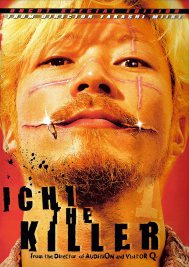
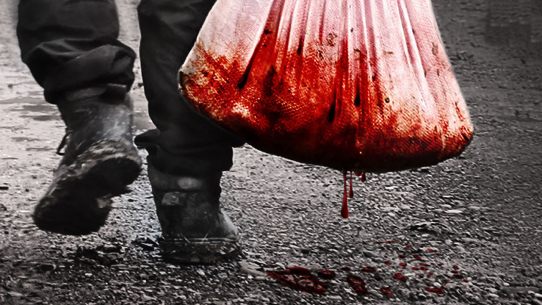
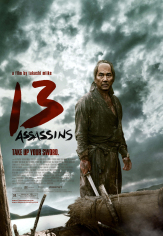 the Killer (2010) and not for lack of trying. (And I haven’t tried Audition [1999], either, though I mean to.) Miike has a great eye, and he constructs breathtakingly beautiful mise-en-scènes. Over Your Dead Body is no exception. It’s a gorgeous film. Of course, the other thing Miike is known for is gore, often sexual in nature. Over Your Dead Body is also no exception in this regard, but the gore was (for me) manageable, and in retrospect, I think the gore really did matter in the context of the story. The film is a sort of cross between revenge-driven horror (a Miike staple, from what I understand) and what some film scholars have called “body horror.” Body horror would include lots of Cronenberg and films like Carrie (1976) that focus on horrors that originate within the human (and most often female) body.
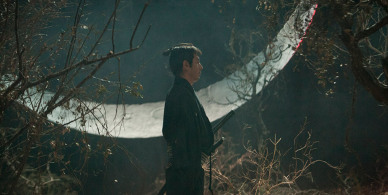
Ebizô Ichikawa as the cruel Kosuke/Iemon
It’s unfair to focus on the gore, however, even though it may be the first thing one remembers, because the majority of this film is gore-free. The film meanwhile makes use of a number of sub-genres, most noticeably that it’s structured as a play-within-a-play. The main characters are rehearsing for a live performance of Yotsuya kaidan, one of the most famous of the more recent Japanese ghost stories (rather than 18th-century ones that became films like Mizoguchi’s wonderful Ugetsu [1953]). These traditional tales often start with romance and end in some richly-deserved and bloody revenge, not unlike Over Your Dead Body‘s frame story, the affair between the play’s lead actors, Kosuke (Ebizô Ichikawa) and Miyuki (Ko Shibasaki). The actors’ affair mirrors or doubles or is maybe caused by the relationship between their characters Iemon and Oiwa and which the actors play again and again. (In addition to being a play-within-a-play, Yotsuya kaidan is said to be based on actual events, adding another layer to the story.) There is some supernatural influence here (keep your eye on that creepy doll), but Miike never offers an explanation for the events, which I think works just fine. The film creates a trance-like sense of suspended animation, and an “origin story” would undo the effect, diluting it into a dreary One Missed Call (2008) sort of affair.
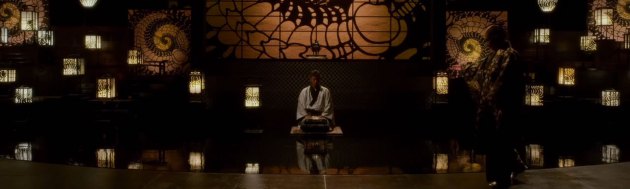
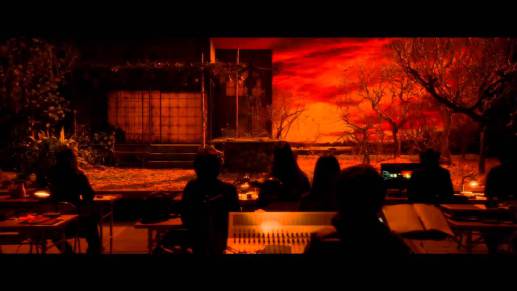 The acting is excellent, particularly Ichikawa as Kosuke/Iemon, but it’s the art direction/staging (by Yuji Hayashida and Eri Sakushima) that blew me away. One of the most interesting things about the film is the way it cheats at being a play. We watch a lot of the performance unfold as though we were an audience at a live play—but an audience with an unnaturally mobile eye, contributing to our growing sense that something here is just…off. The camera weaves around the actors and through the set, avoiding any sense of a static adaptation of a drama. When the camera tracks back to include the rest of the warehouse rehearsal space (see above) with its rows of desks for the director, actors, and technicians, it’s often jarring because we’ve forgotten they’re there. But by the last third of the film, that off-stage space has become part of the play’s stage for us, as well as for Kosuke and Miyuki, apparently trapped in the roles they keep performing.
 Hardcore Miike fans may be disappointed if they’re looking for gore, but as a film and as a story, it’s excellent. (Most of the gore is based in the 19th-century story, the result of Oiwa being poisoned.) If you’ve enjoyed other horror films based in Japanese folklore (which is a lot of ‘em nowadays), this will be right up your alley. It’s also worth seeing if you’re interested in the interplay between stage and screen, though you may have to avert your gaze when Miyuki/Oiwa goes looking for the fetus she’s convinced she’s conceived with Kosuke/Iemon (and I’m guessing that’s not an episode in the earlier version).
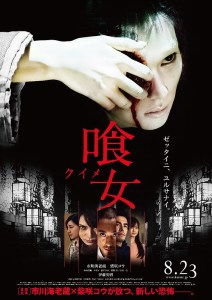
I do want to hunt down some other adaptations of Yotsuya kaidan, as I love Japanese ghost stories almost as much as I love more well-known fairy tales. But in the meantime, I have my final Fest film to write about, Villa Touma, the only film I saw, I am sorry to say, that was directed by a woman.
Also coming up, my much-delayed entry in the British Empire in Film Blogathon, George More O’Ferrall’s adaptation of Graham Greene’s novel The Heart of the Matter (1953). And eventually, I’ll get to Fritz Lang’s Hangmen Also Die. Eventually. Villa Touma and Heart of the Matter were not light-hearted romps, so I may well need some frothy-Lubitsch-type palate cleanser before tackling Lang’s Hangmen (which is, in comparison, almost a light-hearted romp).
Thanks for reading!